
Industrial 3D Printing Services

Four 3D printing technologies to turn your CAD into a real part

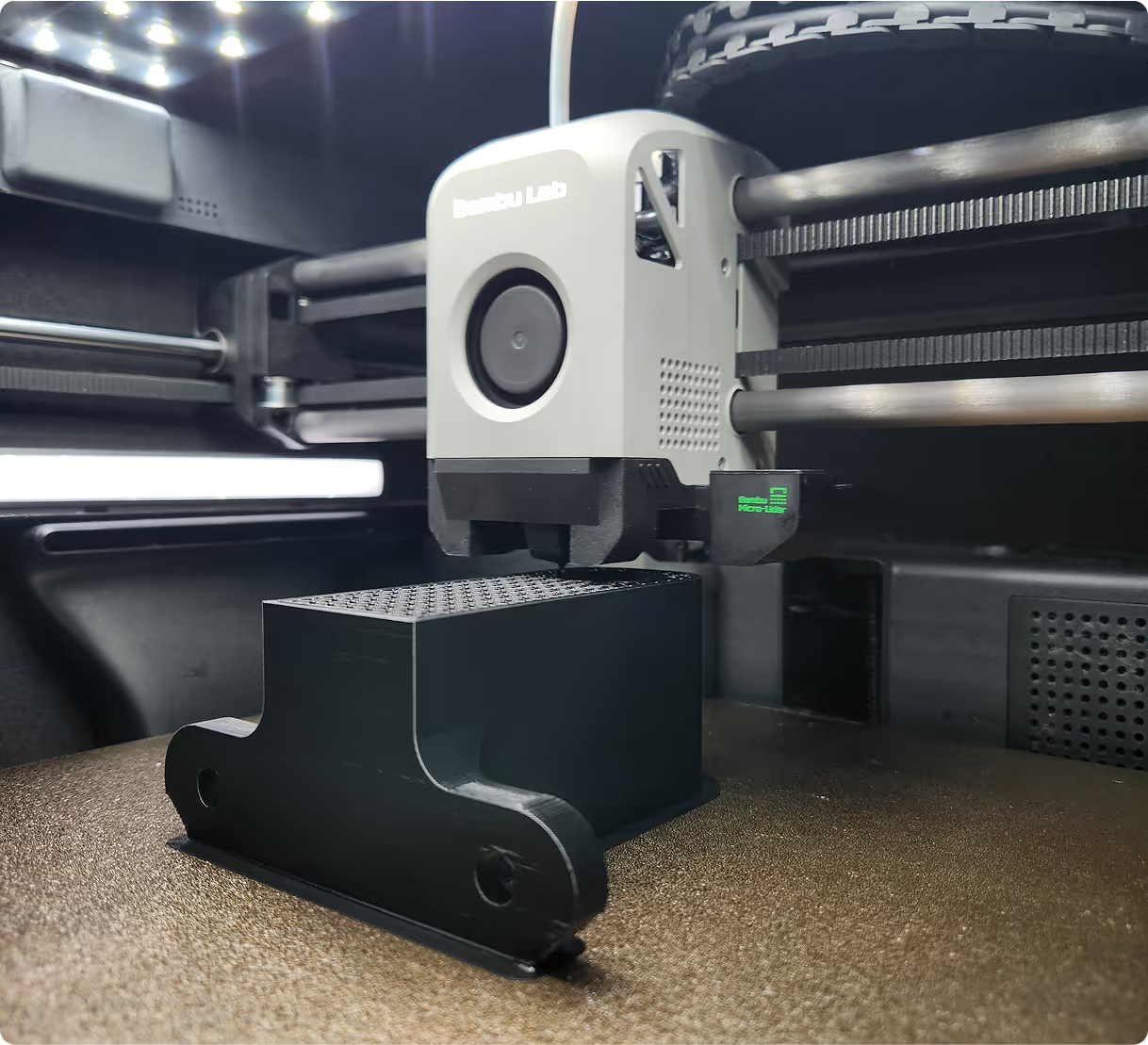
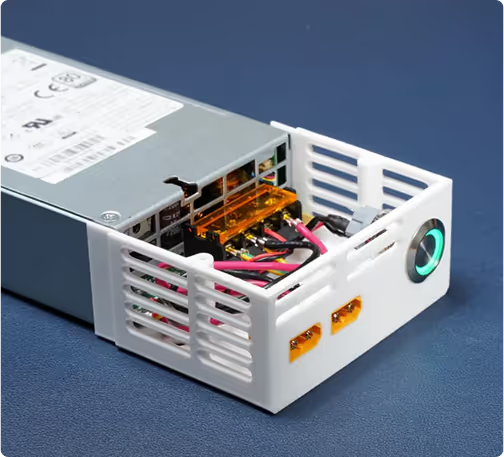
FDM 3D printing White FDM-printed enclosure fitted around a power supply FDM

FDM: Everyday plastic parts

Best for brackets, enclosures and large-format parts up to 1 m³, where detail matters less.

$ Lowest cost2–4 business days
Advantages
  • Lowest cost per part at small scale
  • Quick to turn around & iterate
  • Huge material selection to fit your application
Limitations
  • Visible layer lines unless sanded or finished
  • Weaker between layers than along them
  • Worse detail than other methods, geometries limited
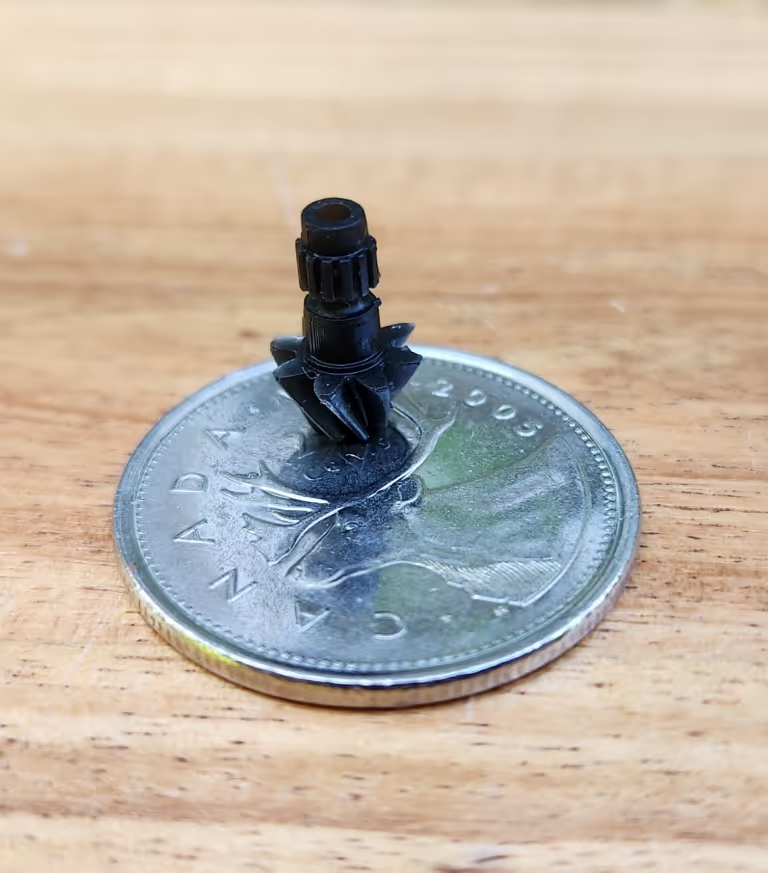
SLA 3D printing Tiny black SLA resin part standing on a coin for scale SLA

SLA: Fine detail, smooth finish

When detail & surface finish matter most.

$$ Low to mid1–4 days
Advantages
  • Finest detail and smoothest surface of any process
  • Tight tolerances, ±0.15 mm
  • Large library of materials to fit your application
Limitations
  • Standard resins are brittle and can crack on impact
  • Most resins yellow and weaken in sunlight
  • Size limitation (200 × 125 × 210 mm)
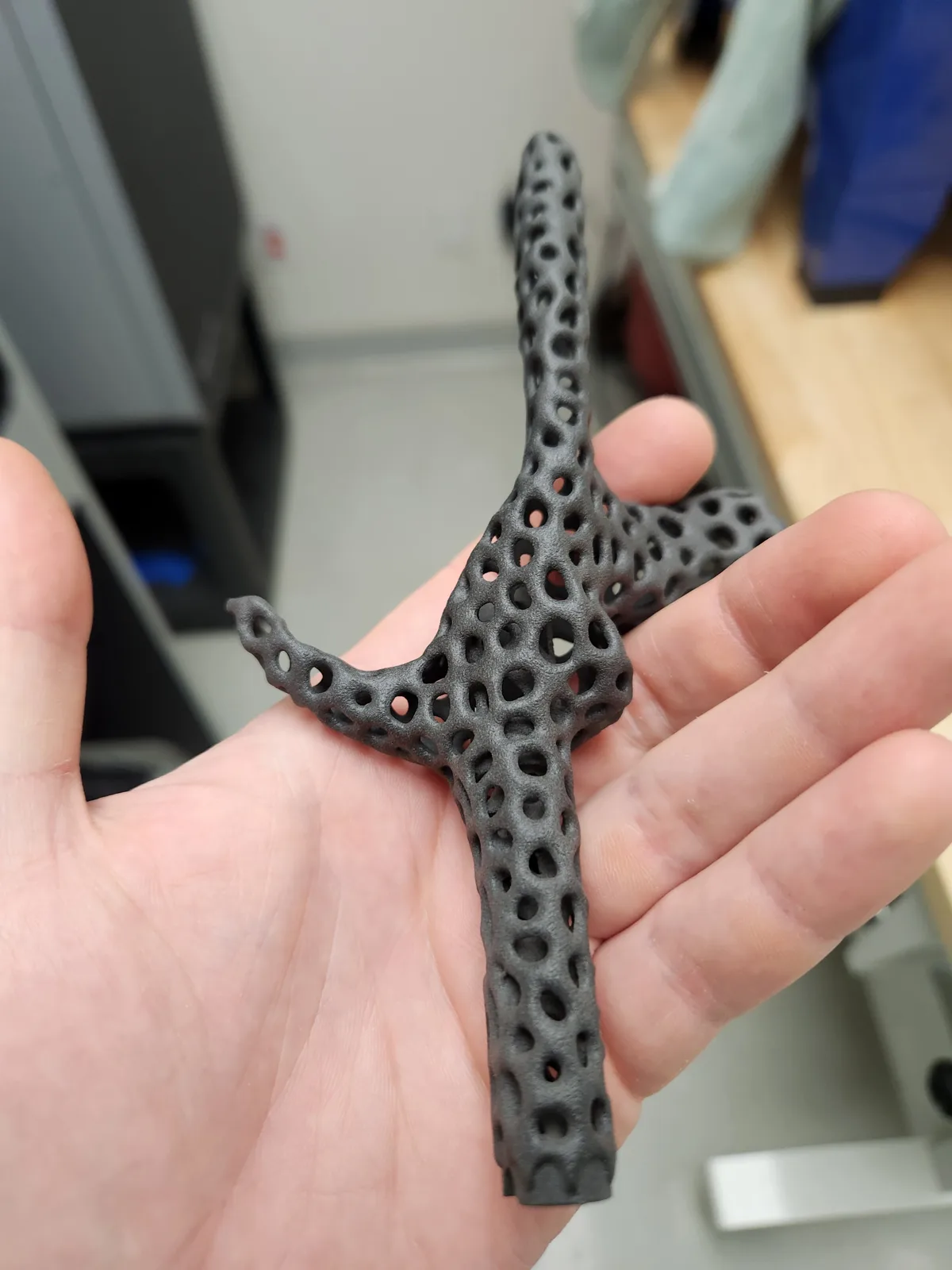
SLS 3D printing Hand holding an SLS-printed PA12 nylon lattice fencing grip SLS

SLS: Production nylon

Best for large batches of parts where strength & repeatability matter.

$$$ Drops in batches2–5 days
Advantages
  • Grainy matte surface finish
  • Very few geometry constraints
  • Price per part drops in batches
Limitations
  • Longer turnaround for small batches
  • Dark grey or dyed colours only, no white or clear
  • Slightly porous; watertight parts need thick walls or sealing
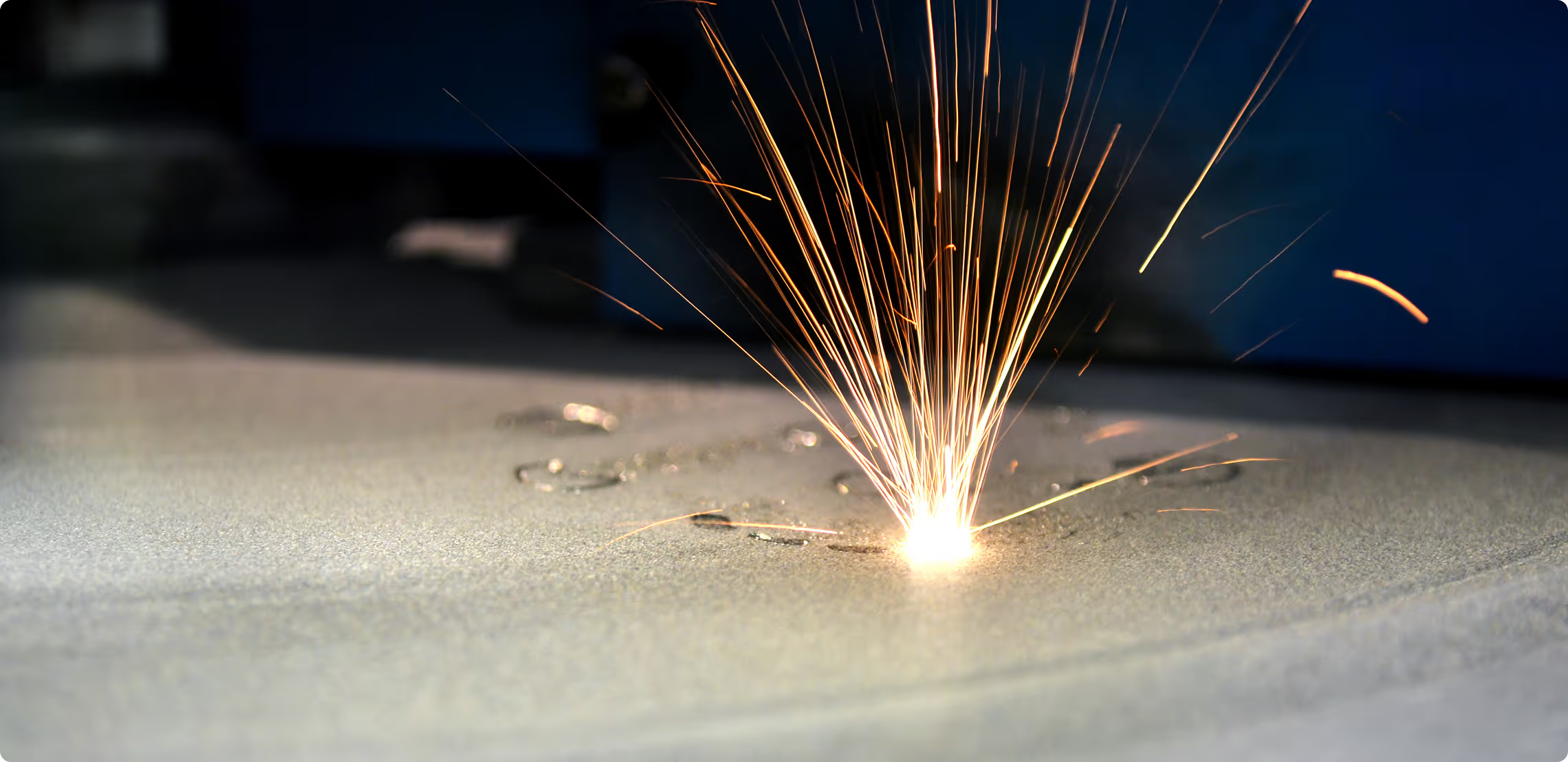
Metal 3D printing Laser melting metal powder, throwing off sparks Metal

DMLS: Real metal parts

Best for heat, heavy loads and complex metal shapes.

$$$$ Highest10–30 days
Advantages
  • Real metal strength for heat and heavy loads
  • Internal channels, lattices and merged assemblies
  • Stainless, aluminum, titanium, Inconel and tool steel
Limitations
  • Highest cost and a 10–30 day lead time
  • Rough as printed; threads and bores need machining
  • Needs supports, and heat can warp thin walls

Hover over or tap a process to see how it works. Swipe to see all four. Tap once for details, again to open. Not sure? Get in touch and we'll recommend one.

How our 3D printing service works

A prototype to test by Friday, or 200 3D printed parts for the production line: here's what a typical small FDM order looks like, from upload to in your hands.

  1. Day 1 · 9:00
    You

    Upload your file

    Pick a process and material, see the price in seconds and order online.

  2. Day 1
    Morin 3D

    A person checks it

    Thin walls, tight fits, the right material. We call if anything needs a tweak.

  3. Day 1–3
    FDM printer with a freshly printed black part
    Morin 3D

    It prints in Victoria

    Your part builds layer by layer on our own machines. No customs, no tariffs.

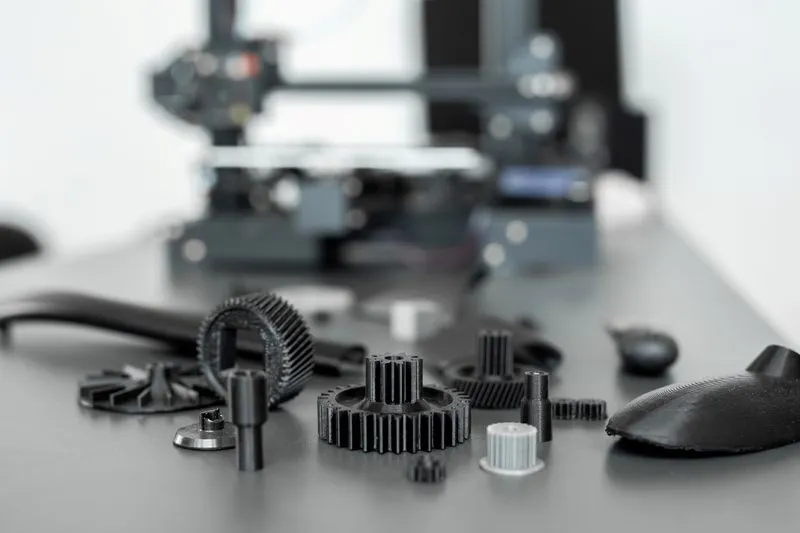
  4. Day 2–4
    Finished black 3D printed parts on a workbench
    Morin 3D

    Finished & inspected

    Supports come off, surfaces are cleaned up and every part is checked.

  5. Day 2–4
    You

    In your hands

    Free pickup in Victoria, or tracked shipping anywhere in Canada.

Other processes: SLA 1–4 days, SLS 2–5, metal 10–30 (quoted by request). Shipping adds 2–5 days outside Victoria.

No 3D file? We can model it or 3D-scan the original.

Need the numbers? Tolerances, layer heights and build sizes for all four processes. specs
Process Tolerance Layer height Max part size Materials Lead time
FDM ±0.25 mm or ±0.5% 0.05–0.6 mm Up to 1 m³ 15+ plastics suited to your application 2–4 business days
SLA ±0.15 mm or ±0.3% 0.025–0.1 mm 200 × 125 × 210 mm 12 resins: tough, clear, silicone, heat-resistant, castable, biocompatible 1–4 days
SLS ±0.3 mm or ±0.5% 0.1 mm 155 × 155 × 295 mm PA12 nylon, dyeable in 5 colours 2–5 days
Metal ±0.2–0.5 mm 0.02–0.06 mm Up to 400 × 400 × 300 mm Stainless, aluminum, titanium, Inconel, maraging steel 10–30 days

Frequently asked questions

Which 3D printing technology should I choose?

It depends on your part’s requirements. FDM is a great value for functional parts and large prototypes. SLA is best when fine detail and smooth surfaces matter. SLS produces durable nylon parts without support structures (and with more uniform strength than FDM). Metal is for high-strength, high-temperature, or complex metal parts—often combined with machining for critical features. Not sure? We can recommend the best process based on your file and use case.

How fast can you deliver parts?

Typical lead times are 2–4 business days for FDM, 1–4 business days for SLA, 2–5 business days for SLS, and 10–30 business days for metal—depending on part size, quantity, and finishing. We offer local pickup in Victoria and expedited shipping across Canada when available.

What file formats do you accept?

We accept STEP (.step/.stp, preferred for engineering parts), STL, 3MF, and OBJ. If you’re exporting a mesh (STL/3MF/OBJ), make sure it’s watertight/manifold and correctly scaled to mm (make sure to indicate when a file has custom scaling). We’ll review every file and reach out if anything needs adjustment.

What are the quickest ways to lower my project cost?

Add more parts to your order—we offer volume discounts. Increase the layer height if surface finish isn't critical. Let us recommend the most cost-effective technology and material for your application.

Can you handle CAD design if I only have a sketch?

Absolutely. Our in-house design team can turn your sketch, photo, or physical object into a production-ready 3D model. We also offer 3D scanning services for reverse engineering existing parts.

How large can you print?

Typical in-house max build sizes are: FDM up to 1m³, SLA up to 200×125×210mm, and SLS up to 155×155×295mm. For larger parts, we can split and assemble them cleanly—and for very large FDM prints we can source partner production (up to 2100×700×900mm, project dependent). Metal build sizes vary by alloy and system; ask us if you have a specific envelope requirement.

Ready to Start Your Project?

Upload your file, pick a material, and get your parts printed. No back-and-forth emails. No guesswork.